Monday, March 7, 2011

Critiquing Tools

Art Vocabulary List

ForegroundThe part of a picture that is nearest to and in front of the viewer.
 Palette- a palette is either a given, finite set of colors for the management of digital images (that is, a color palette), or a small on-screen graphical element for choosing from a limited set of choices, not necessarily colors (such as a tools palette).
Harmony- In order to create harmony and unity, you must design a page or site using consistency and repetition.
Focal Point- The point of the design where the eye is drawn to. A focal point is the most important part of the page or the part of the page that is the most dominant.
Flowing- designed or arranged to offer the least resistant to fluid flow, easiest for the eye to move around the page or design.  

Adjective List

TackyLacking style or good taste, tawdry.
Negative space- Negative space, in art, is the space around and between the subject of an image. Negative space may be most evident when the space around a subject, and not the subject itself, forms an interesting or artistically relevant shape, and such space is occasionally used to artistic effect as the "real" subject of an image. The use of negative space is a key element of artistic composition.
Curvedgenerally speaking, an object similar to a line but which is not required to be straight.
Smooth- Having a texture free from roughness and stubble. Which creates a smooth surface. 
Figure and ground- Figure ground is a visual relationship between foreground and background. This is important to the perception of images, as the edges form the image that we see.

Principles and Elements of Design List
Elements

Line- Line is the basic element that refers to the continuous movement of a point along a surface, such as by a pencil or brush. The edges of shapes and forms also create lines. It is the basic component of a shape drawn on paper. Lines and curves are the basic building blocks of two dimensional shapes like a house's plan. Every line has length, thickness, and direction. There are curve, horizontal, vertical, diagonal, zigzag, wavy, parallel, dash, and dotted lines.

Colour- Color is seen either by the way light reflects off a surface, or in colored light sources. Color and particularly contrasting color is also used to draw the attention to a particular part of the image. There are primary colors, secondary colors, and tertiary colors. Complementary colors are colors that are opposite to each other on the color wheel. Complementary colors are used to create contrast. Analogous colors are colors that are found side by side on the color wheel. These can be used to create color harmony. Monochromatic colors are tints and shades of one color. Warm colors are a group of colors that consist of reds, yellows, and oranges. Cool colors are group of colors that consist of purples, greens, and blues.

Shape- Shape is defined as an area that stands out from the space next to or around it due to a defined or implied boundary, or because of differences of value, color, or texture. Shapes can also show perspective by overlapping. They can be geometric or organic. Shapes in house decor and interior design can be used to add interest, style, theme to a design like a door. Shape in interior design depends on the function of the object like a kitchen cabinet door. Natural shapes forming patterns on wood or stone may help increase visual appeal in interior design. In a landscape, natural shapes, such as trees contrast with geometric such as houses.

FormForm is any three dimensional object. Form can be measured, from top to bottom (height), side to side (width), and from back to front (depth). Form is also defined by light and dark. There are two types of form, geometric (man-made) and natural (organic form). Form may be created by the combining of two or more shapes. It may be enhanced by tone, texture and color. It can be illustrated or constructed.

Principles
Stability- The condition of being stable or in equilibrium, and thus resistant to change.

Dynamics- In the field of physics, the study of the causes of motion and changes in motion is dynamics. In other words the study of forces and why objects are in motion.

Rhythm- Rhythm - is a movement in which some elements recurs regularly.  Like a dance it will have a flow of objects that will seem to be like the beat of music.

Scale- Scale in drawing refers to the proportion or ratio that defines the size relationships.  Models, architectural plans, maps and paintings/drawings all use scale to create the illusion of correct size relationships between objects and figures.


Style Time Line

Metaphysical painting      
Metaphysical Painting is an Italian art movement, born in 1917 with the work of Carlo CarrĂ  and Giorgio de Chirico in Ferrara. The word metaphysical, adopted by De Chirico himself, is core to the poetics of the movement. They aimed to depict an alternative reality which engaged most immediately with the unconscious mind. In this style of painting, an illogical reality seemed credible. Using a sort of alternative logic, CarrĂ  and de Chirico juxtaposed various ordinary subject typically including starkly rendered buildings, trains, and mannequins.

Joe Joubert, Laura corbier


Lyrical Abstraction                                          
Lyrical Abstraction (Color and Mood) is related in spirit to Abstract Expressionism. Lyrical Abstraction represents an opening to personal expression, romantic abstraction in a loose gestural style. Existed in the 1940's.

Karin Kuhlmann.Tom McNease
Pop Art                                                              
Pop art is an art movement that emerged in the mid 1950s in Britain and in the late 1950s in the United States. Pop art challenged tradition by asserting that an artist's use of the mass-produced visual commodities of popular culture is contiguous with the perspective of fine art. Pop removes the material from its context and isolates the object, or combines it with other objects, for contemplation. The concept of pop art refers not as much to the art itself as to the attitudes that led to it.

Andy Warhol, Jim Dine

Optical Art                                                      
Style to make art an optical illusion.
Optical art is a method of painting concerning the interaction between illusion and picture plane, between understanding and seeing. When the viewer looks at them, the impression is given of movement, hidden images, flashing and vibration, patterns, or alternatively, of swelling or warping. Op painters and sculptors used geometric designs in order to create feelings of movement of vibration, sometimes vibratant colours and other times simply black and white.
Evolved in the 1960's.

Bridget Riley, Victor Vasarely


Digital Art
Digital art is a general term for a range of artistic works and practices that use digital technology as an essential part of the creative and/or presentation process. Since the 1970s, various names have been used to describe the process including computer art and multimedia art, and digital art is itself placed under the larger umbrella term new media art. The techniques of digital art are used extensively by the mainstream media in advertisements, and by film-makers to produce special effects. Desktop publishing has had a huge impact on the publishing world, although that is more related to graphic design.

Christopher Haines, Adrien Donot


Street Art                                                           
Street art is any art developed in public spaces — that is, "in the streets" though the term usually refers to unsanctioned art, as opposed to government sponsored initiatives. The term can include traditional graffiti artwork, stencil graffiti, sticker art, wheatpasting and street poster art, video projection, art intervention, guerrilla art,flash mobbing and street installations. Typically, the term street art or the more specific post-graffiti is used to distinguish contemporary public-space artwork from territorial graffiti, vandalism, and corporate art.
Whereas traditional graffiti artists have primarily used free-hand spray can paints to produce their works. Street art encompasses many other media and techniques, including: LED art, mosaic tiling, murals, stencil art, sticker art, street installations, wheatpasting, woodblocking, video projection, and yarn bombing.
1970- France

Banksy, Alexandros Vasmoulakis

Realism                                                                
Realism is defined by the accurate, unembellished, and detailed depiction of nature or contemporary life. The movement prefers an observation of physical appearance rather than imagination or idealization. In this sense, Realism can be found in movements of many other centuries.
1850-1880

Henri Fantin, Jean-Louis Forain

Toyism                                                           
is an art movement that rose to prominence in The Netherlands in the 1990s. Introduced by an artist using the pseudonym Dejo at the Veenmuseum in 1992, the toyist style of painting emphasizes narrative depictions featuring figurative rather than abstract objects focusing on aspects of the human condition. Stylistically, it features the heavy use of outlining, bold colors and craftsmanship. Toyist artists select a pseudonym and an icon which is incorporated into their paintings.

Artist - Missy Sassy, Miss Fihi

Shock Art                                                           
A contemporary art that incorporates disturbing imagery, sound or scents to
create a shocking experience. While the art form's proponents argue that it is "embedded with social commentary" and critics dismiss it as "cultural pollution", it is an increasingly marketable art, described by one art critic in 2001 as "the safest kind of art that an artist can go into the business of making today". While shock art attracts curators and makes headlines, Reason magazine's 2007 review of The Art Newspaper suggested that traditional art shows continue to have more popular appeal
Evolved in the 20th century.

Andres Serrano, Marcel Duchamp, Damien Hirst

Shin Hanga                                                            
Also known as New Printing, was an important 20th century movement in Japanese printmaking. Shin Hanga print artists often revisited the popular subjects of the classical period of Ukiyo-e: beautiful women, famous actors, and stylized landscapes. In contrast with Sosaku Hanga, or Creative Prints, which are self-published, Shin Hanga prints were produced in the traditional method with artists working in tandem with printers and publishers to create collaborative works. Products of a transitional era, Shin Hanga prints often incorporate modern elements and sensibilities into familiar environments, blending nostalgia for the old with a sense of wonder for the new.
Takashi Ito,Benji Asada


http://wwar.com/masters/movements/realism.html
http://www.davidsongalleries.com/subjects/shinhanga/shinhanga.php
http://arthistory.about.com/od/arthistory101/a/toyism.htm
http://mapesy09.blogspot.com/2010/11/international-typographic-style.html

Monday, February 21, 2011


1) Who are the Titans?
the gods, 7 or 6
2) Are the any interesting motifs you see frequently appearing (Eg. Lightning bolts)? How do you interpret their meaning? Can you name a modern version, of this motif, used today?
pillers represent zeus and his strength and power and the heavens. 
swords represent power and the ability to fight. 
wings - power of flight, travels and friendliness between animals and humans.

3) Is your Greek character in the movie? If so, does the film's interpretation match your research?
Yes, only has one line so can't really tell, but his description have blonde hair wasn't right but him having long hair matched. Research said Apollo was good looking which was reflected in the movie. 
5) Are any of the characters, in the movie, related (Eg. a mother or father, wife or husband, brother or sister) to your Greek myth? If so, how?
Zeus is Apollos father
6) Is their a constellation of stars named after your Greek character?
No.
7) How is Medusa killed? Does your Greek character have a weakness?
Stabbed in the tail and head chopped off, to use her eyes. 
his weakness...like his father was his addiction to women

Monday, February 14, 2011

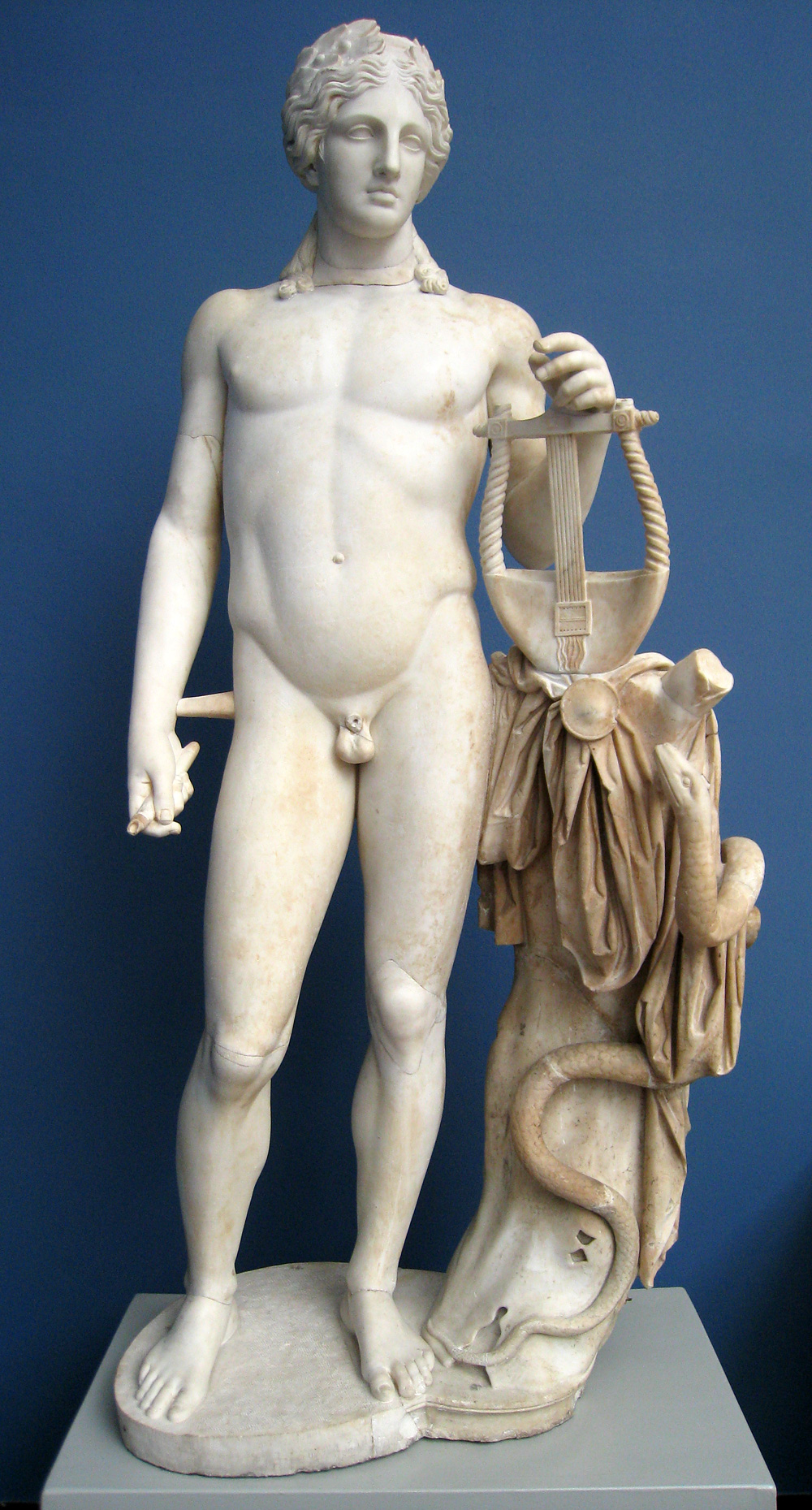
Apollo Research


Appearance

Sometimes also known as Phoebus.
A young man with curly golden hair and blue eyes, Apollo is depicted as a handsome beardless young man, often with a kithara or bow in his hand, or reclining on a tree .


History

He was born on the island Delos by Leto, a Titan's daughter, and Zeus. The island was to be the most sacred of islands, and ruins of many temples can still be seen there. His sister was Artemis, the goddess of hunting and protecter of young women. 
After he killed the huge snake Python in Delphi by the mountains Parnassus, the site was dedicated to him. There, the Omphalos, the navel, stood - a point believed by the ancient Greeks to be the centre of the earth. His oracle there was a place many people, commonmen and rulers, came to consult the priestess, Pythia, about their future. In Delphi games were held in Apollo's honour, originally every eight years but later every four. The Pythian games were both athletic and musical.
In many ways, Apollo personified the perfect man according to ancient Greek standards: he would entertain the other gods by playing the lyre, and he was also a brilliant archer and runner,
considered to be the first winner at the Olympic Games. He protected young men, was a god of agriculture and also was a healer. He was also thought to be the most beautiful of gods.


Adventures

His very first adventure was to kill the serpent of Pytho. The serpent guarded over Sibyl an oracle and also destroyed crops and villages in the area. Apollo killed it with his bow and took charge of the oracle. However, to make amends for killing the beast he had to serve king Admetus for nine yeras as a cattle herder. After killing Python (the serpent of Pytho) he dedicated a bronze tripod to the sanctuary and bestowed divine powers upon one of the priestesses.


Relationships

There are several stories about Apollo as a man desperately in love, avenging the women who will not return his feelings: Cassandra was cursed to never be believed when she saw terrible things in the future, Daphne had to become a tree to escape him and he abandoned princess Creusa of Athens and their child.
Apollo also loved men. In the story of the young man Hyacinthos Apollo accidentily kills his young lover with a discus, and is then transformed into the flower with the same name, where the letters AI AI can be read as the gods lament.
But Apollo was also the sender of the plague. His wrath punished the Greeks when he fired his arrows of plague upon the Greek camp at the Trojan war. As a healer, he teaches the people the importance of cleanliness, and he is the father of Asclepios, the god of medicine.


Symbols

Apollo's most common attributes were the bow and arrow. Other attributes of his included the kithara, the plectrum and the sword. Another common emblem was the sacrificial tripod, representing his prophetic powers. The Pythian Games were held in Apollo's honor every four years at Delphi. The bay laurel plant was used in expiatory sacrifices and in making the crown of victory at these games. The palm was also sacred to Apollo because he had been born under one in Delos. Animals sacred to Apollo included wolves, dolphinsswans, cicadas (symbolizing music and song), hawks, ravens, crows, snakes ,mice and griffins, mythical eagle–lion hybrids of Eastern origin.


Evolution

Apollo has developed over the years into hundreds of company logos, mostly incorporating his face or representing his strength, sportsmanship and relationship with the sun, such as phones, theatres, design , bike and recycling companies.

Apollo NASA first accomplished during the Apollo 11 mission on July 20, 1969 when astronauts Neil Armstrong and Buzz Aldrin landed the spacecraft.


List of sports


Archery 
running/athletics
AFL
triathlon 
rowing


Sources

Wikipedia.com
About.com
In2greece.com

Monday, February 7, 2011

apollo

Apollo - god of truth, music, intellectual pursuits, healing and the sun.


http://en.wikipedia.org/wiki/Apollo